
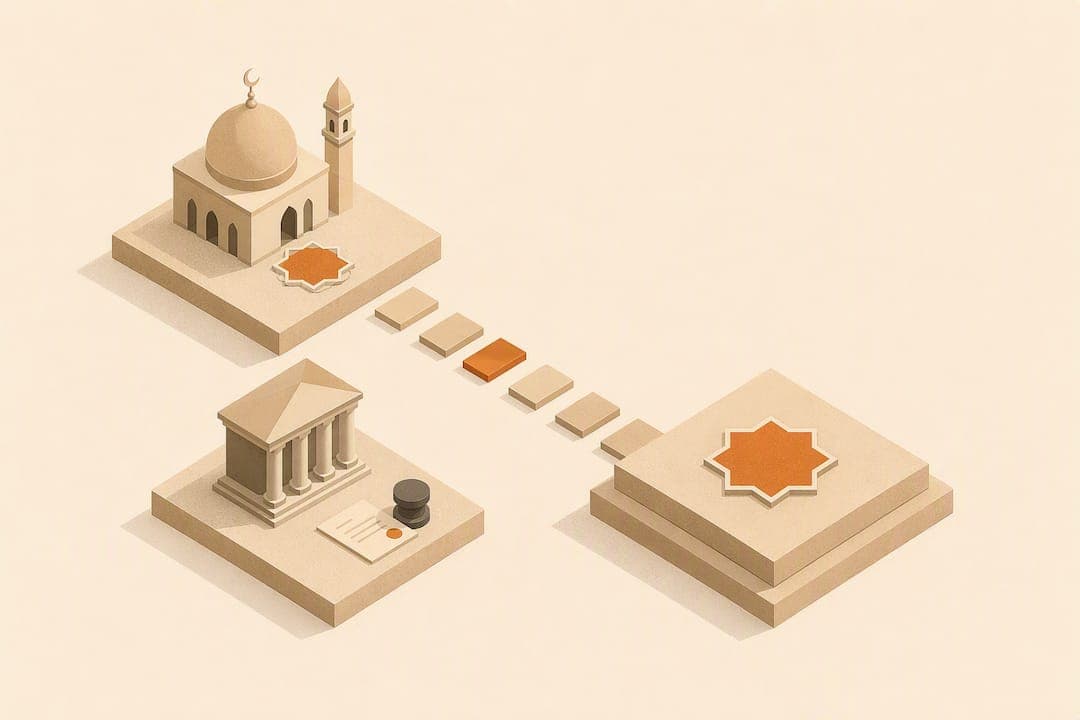
A divorced Muslim can remarry once two things are settled: the religious dissolution (through talaq, khulʿ, faskh or tafwid, followed by a completed iddah) and, separately, a legal civil divorce recognised by English or Welsh courts if the marriage was civilly registered. Skipping either track risks a "limping marriage" that leaves you religiously free but legally still married, or vice versa. If you're unsure which box is ticked, get written confirmation from a Sharia council and check your civil decree before taking a single step towards a new nikah.
TL;DR:
- Ensure both civil and religious divorces are completed and documented correctly before remarrying to avoid legal limbo and potential conflicts.
- Recognize that Islamic divorce types (talaq, khulʿ, faskh, tafwid) have different legal and procedural implications, especially regarding mahr and revocability.
- Confirm that your civil divorce is finalized with a decree absolute or similar, and obtain official religious divorce certificates from a recognized Sharia council.
- Wait for the end of iddah and verify civil divorce completion to prevent inadvertent bigamy or legal complications in remarriage.
- Use reputable legal and religious sources to verify your status and consult qualified professionals before planning a second marriage.
Table of Contents
- Divorced Muslim marriage: understanding the four types of Islamic divorce
- Does an Islamic divorce count as a legal divorce in the UK?
- What steps confirm both a civil and Islamic divorce?
- How long is iddah and does mahr have to be repaid?
- Who handles mahr disputes and financial settlements?
- How does divorce affect children and parental responsibility?
- When can you remarry, and what does nikah halala actually mean?
- Where can divorced Muslims get counselling and legal help?
- What should you do in the next 30 to 90 days?
- Why supporting second marriages properly matters
- How Zawaj supports divorced Muslims ready to remarry
- Where to check the facts and get further help
- Sources
Divorced Muslim marriage: understanding the four types of Islamic divorce
Getting your terminology right matters, because the type of Islamic divorce you have determines your rights, your waiting period, and whether you need a solicitor as well as a scholar. There isn't one single "Islamic divorce" process; there are four distinct routes, each with different consequences for a divorced Muslim marriage and what comes after it.
Talaq is divorce initiated by the husband, pronounced verbally or in writing. The first and second pronouncements are revocable (talaq raj'i), meaning the couple can reconcile without a new nikah during iddah. A third pronouncement, or a talaq stated as final, becomes irrevocable (talaq bain) and ends the marriage outright. Witnesses aren't universally mandated by every school of thought, but recording the date and having at least one witness is standard practice among UK Sharia councils, mainly because it prevents disputes later about when the divorce actually took effect.
Khulʿ is divorce initiated by the wife, typically involving her returning some or all of the mahr (dowry) to the husband in exchange for release from the marriage. It requires her husband's agreement or, where he refuses, a Sharia council's ruling in her favour.
Faskh is judicial annulment, granted by a Sharia council or qadi when the husband is absent, abusive, unable to maintain the marriage, or otherwise in breach of his obligations. Unlike khulʿ, faskh doesn't automatically require the wife to forfeit her mahr.
Tafwid is a delegated right, agreed at the time of nikah, giving the wife the authority to pronounce her own talaq under specified conditions.
A few misunderstandings recur constantly:
- Many assume all four routes require the husband's consent. They don't. Faskh exists precisely because khulʿ alone isn't always available.
- People often conflate "irrevocable" with "instant". Even talaq bain still triggers an iddah period before remarriage.
- Different schools of jurisprudence (Hanafi, Shafi'i, Maliki, Hanbali) treat evidentiary requirements and mahr repayment differently, so a ruling from one Sharia council may differ slightly from another's approach to the same facts.
Does an Islamic divorce count as a legal divorce in the UK?
No. In England and Wales, an Islamic divorce on its own does not end a civil marriage, and if your nikah was never civilly registered, you may not have had a legally recognised marriage to dissolve in the first place. A nikah performed without civil registration doesn't automatically create legal marriage status, which means a purely religious divorce afterwards leaves your civil status untouched, whatever it was.
This split creates what family lawyers call a "limping marriage": married in the eyes of one system, divorced in the eyes of another. It's more common than most people realise, and the consequences aren't abstract.
What a limping marriage can cost you:
- Inability to remarry civilly while still legally married to someone else
- Complications with inheritance if a former spouse is technically still your legal next of kin
- Disputes over matrimonial finances resurfacing years after you believed the marriage was over
- Confusion for children's legal status and your own immigration or benefits paperwork
Statistic in focus: Academic research on mixed-status marriages has documented how unsynchronised civil and religious divorces routinely leave people in legal limbo for years, often without them realising until they try to remarry or resolve an estate.
Recognition of a purely religious dissolution by UK courts isn't impossible, but it's inconsistent and fact-specific. If your nikah wasn't registered as a civil marriage, you likely need no civil divorce at all, only the Islamic one. If it was registered, or you also had a separate civil ceremony, you need a civil decree regardless of what any Sharia council decides. When in doubt, treat both tracks as mandatory until a solicitor confirms otherwise.
What steps confirm both a civil and Islamic divorce?
Work through both tracks in parallel rather than waiting for one to finish before starting the other. Delay is usually what creates limping marriage problems in the first place.
Civil track:
- Check whether you have a decree absolute (or, under the current system, a final divorce order) rather than just a decree nisi, which doesn't end the marriage.
- If your nikah was never civilly registered, confirm with a solicitor whether any civil divorce is even necessary.
- Contact a family solicitor to review your paperwork, particularly if the marriage or divorce involved another country.
- Check your eligibility for subsidised help through Gov, especially if finances or domestic abuse are involved.
Religious track:
- Contact a recognised Sharia council, such as the Muslim Law (Shariah) Council UK.
- Request a written certificate confirming the type of divorce granted and the date it took effect.
- Keep a record of witnesses, dates of pronouncement, and any correspondence with your former spouse.
- Retain copies indefinitely. You'll need them again if you remarry, and again if anyone ever disputes your marital history.
If your Islamic divorce happened overseas, don't assume it transfers automatically. UK courts assess overseas Islamic divorces case by case, weighing procedure, notice given to both parties, and domicile at the time. A divorce granted informally abroad, without proper notice or documentation, may simply not be recognised here.
Pro Tip: Ask your Sharia council for a certificate that states the exact Islamic legal basis (talaq, khulʿ or faskh) in writing, not just "divorced". Solicitors and other councils will ask for this specificity later, and re-requesting it months afterwards is slower than getting it right the first time.
How long is iddah and does mahr have to be repaid?
Iddah is the mandatory waiting period following divorce, during which remarriage isn't permitted and, in the case of revocable talaq, reconciliation remains possible without a new nikah. For most women, it lasts three menstrual cycles or three lunar months if periods have stopped for reasons other than pregnancy. If the wife is pregnant, iddah continues until birth, regardless of how long that takes. The purpose is twofold: confirming there's no pregnancy from the previous marriage, and giving both parties a genuine window for reconciliation before the split becomes final.
Mahr repayment causes more confusion than almost anything else in this process. The common assumption is that khulʿ automatically means giving the whole dowry back. It doesn't. Requirements for returning mahr in khulʿ vary by circumstance and by the ruling body involved; some Sharia councils and courts decline to insist on full repayment, particularly where the husband's conduct contributed to the breakdown.
Statistic in focus: A frequently overlooked distinction: a woman granted faskh, rather than khulʿ, is often not required to return her mahr at all if the council rules in her favour, since faskh is a judicial finding of fault or incapacity rather than a mutual release.
Faskh itself typically needs supporting evidence, not just an assertion of unhappiness. Councils generally expect proof of things like abandonment, financial neglect, abuse, or the husband's inability to fulfil marital obligations, sometimes through witness statements, correspondence, or police or medical records where relevant.
- Talaq: no mahr repayment expected from the wife
- Khulʿ: partial or full mahr repayment possible, negotiable
- Faskh: mahr repayment usually not required if granted on fault grounds
Who handles mahr disputes and financial settlements?
Mahr sits in an odd legal space in England and Wales. It's a religious obligation, but courts have sometimes treated it as a contractual debt or factored it into matrimonial finance settlements, depending on how the marriage was structured and whether mahr was documented at the time of nikah. Because a nikah without civil registration may carry no automatic legal weight, an unregistered mahr agreement can be even harder to enforce through the civil courts, which makes early documentation critical rather than optional.
For civilly recognised marriages, English courts divide matrimonial assets under the Matrimonial Causes Act 1973, focusing on needs, contributions and fairness rather than religious entitlement specifically. Mahr can sometimes be raised as evidence of an agreed financial arrangement, but it isn't guaranteed automatic enforcement outside that framework.
What to gather before any settlement discussion:
- The original nikah document stating the mahr amount and payment terms
- Bank records or receipts showing any partial mahr payment already made
- Any written agreement about property, gifts, or maintenance made at the time of marriage
- Correspondence where either party acknowledged the outstanding mahr
Pro Tip: Never waive mahr verbally "to keep things amicable". Get any waiver, reduction, or repayment plan in writing and dated, even if it's a simple signed note. Informal agreements are the single biggest reason mahr disputes resurface years later, often once a new marriage or inheritance is already underway.
Avoid rushing into an informal financial settlement without a solicitor's review, particularly where property or children are involved. A five minute conversation now is cheaper than a contested claim later.
How does divorce affect children and parental responsibility?
Parental responsibility in England and Wales doesn't automatically end with divorce, civil or Islamic. Both parents typically retain legal responsibility for decisions about a child's health, education and welfare unless a court order says otherwise, and family courts apply a welfare-first principle that takes precedence over any private religious or cultural preference about custody.
Practically, this means:
- Mediation is usually the first step, and often required before applying for a court order, to agree on living arrangements and contact.
- A Child Arrangements Order formalises where a child lives and how time is split, if parents can't agree privately.
- Emergency orders exist for situations involving safety concerns, and social services can be involved where a child is at risk.
- Faith-based preferences about upbringing (religious education, dietary practice, modesty norms) can be raised in proceedings, but courts prioritise the child's overall welfare over any single parent's religious wishes if there's genuine disagreement.
The gap between what a divorced Muslim parent might expect from a faith-based process and what a civil family court actually delivers catches people out regularly. Sharia councils can offer guidance and religious rulings on custody preferences, but they hold no binding legal authority over UK child arrangements. If there's a dispute, the civil court's order is what's enforceable, not a council's religious opinion.
When can you remarry, and what does nikah halala actually mean?
Remarriage becomes permissible once iddah has ended and the Islamic divorce is finalised, and, separately, once any necessary civil divorce is legally complete. Both conditions apply where relevant. Get either wrong and your new nikah risks being religiously premature or civilly bigamous.
Nikah halala refers to a specific and narrow scenario: after a third, irrevocable talaq, a woman is not permitted to remarry her former husband unless she has first validly married another man, that marriage has ended naturally (through his death or a genuine divorce), and she has completed a further iddah. It exists as a deterrent against the casual, repeated use of talaq, not as a loophole to be engineered.
The serious misconception, and the one that causes real harm, is the idea that a woman can arrange a short-term "contract marriage" purely to satisfy this condition and then divorce immediately by pre-agreement. Scholars across mainstream schools of thought overwhelmingly reject this practice as a manipulation of the rule's intent, and it should never be treated as a standard remarriage pathway. Anyone advising a "quick fix" halala arrangement is not offering sound religious guidance.
Before remarrying, whether to a former spouse or someone new:
- Confirm iddah has fully ended and get this in writing from a Sharia council if there's any doubt.
- Confirm any necessary civil divorce is legally finalised, not just filed.
- Consult a trusted, qualified scholar about your specific situation rather than relying on general assumptions.
- Consider pre-marriage counselling, particularly if children, blended families, or unresolved grief from the first marriage are part of the picture.
Pro Tip: If a scholar or "matchmaker" suggests a temporary marriage purely to satisfy halala conditions, treat that as a red flag and seek a second opinion from an established Sharia council. This is one of the most misused areas of Islamic family law, and the misuse causes real, lasting damage.
Where can divorced Muslims get counselling and legal help?
Three distinct types of support exist, and mixing them up wastes time. A Sharia council rules on religious status. A solicitor handles civil legal status. A counsellor helps you process the emotional aftermath, and increasingly, faith-aware counsellors do all three roles' worth of listening without overstepping into the other two.
What each actually does:
- Sharia councils (such as the Muslim Law (Shariah) Council UK) issue religious divorce certificates and offer faith-sensitive counselling around £50 per hour where fees are published.
- Family solicitors handle decree absolute or final orders, financial settlements, and child arrangement orders, none of which a Sharia council can legally enforce.
- Muslim-focused counselling services, including Sakoon's culturally aware couples and relationship counselling, specialise in the emotional and identity rebuilding work that follows a divorce within an Islamic framework.
When choosing a provider, ask directly whether they have experience with your specific situation, whether that's domestic abuse, cross-border marriage, or blended-family remarriage, and check that they understand safeguarding boundaries. Some councils will decline involvement where a non-molestation or protective order is active, so disclose any existing legal orders upfront rather than letting it surface mid-process.
What should you do in the next 30 to 90 days?
Momentum matters here. Uncertainty about your status tends to compound rather than resolve itself, so treat this as a rough timeline rather than a rigid deadline.
- Immediately: Confirm whether you hold a decree absolute or final civil divorce order, not just a decree nisi.
- Immediately: Request written Islamic divorce documentation from a recognised Sharia council if you don't already have it.
- Immediately: Calculate where you stand in iddah, and gather your original nikah paperwork and any mahr records.
- Within 30 days: Book a consultation with a family solicitor, particularly if your marriage crossed borders or wasn't civilly registered.
- Within 30 to 60 days: Consider mediation or counselling if children or unresolved finances are involved.
- Within 60 to 90 days: Prepare financial documentation for any settlement, and, once both tracks are confirmed complete, plan remarriage steps with a scholar's guidance.
Pro Tip: Keep a single folder, physical or digital, with every certificate, order, and piece of correspondence in one place. When you eventually remarry, an imam or registrar will likely ask for proof of both divorces, and scrambling to find a document from three years ago is avoidable stress.
If there's any hint of a protective order, threats, or forced-marriage pressure at any stage, that overrides every other item on this list. Contact a solicitor or the police first.
Why supporting second marriages properly matters
Divorce carries enough stigma in some Muslim communities without the added confusion of "am I actually free to remarry?" hanging over people for years. What strikes me most, looking at how often civil and religious status drift apart, is that the confusion is rarely about faith itself. Most people understand the religious principles well enough. What trips them up is the paperwork gap between two systems that don't automatically talk to each other.
That gap is exactly why platforms serving divorced Muslims need to take verification and privacy seriously rather than treating a second marriage as a lesser event than a first one. Faith-sensitive counselling, as post-divorce support resources aimed at emotional recovery and rebuilding rightly emphasise, matters as much as legal clarity. Getting both right is what lets someone move forward with confidence rather than lingering doubt.
If you're weighing up a faith-aligned route back into marriage, it's worth understanding what a platform built specifically for this actually offers before you commit time to it.
— Muhammad
How Zawaj supports divorced Muslims ready to remarry
Second marriages deserve the same seriousness and dignity as a first, not a quieter, awkward version of the process. Zawaj is built around that principle: profile verification, targeted filters for practice and background, and proposal-based matching that skips the endless swiping culture common on general dating apps.

Once you've confirmed your civil and Islamic divorce are both settled, the practical question becomes finding someone whose values, background and intentions genuinely align with yours. Zawaj's detailed profiles let you state upfront that you're divorced and open to a second marriage, so there's no awkward reveal later and no wasted conversations with people who aren't looking for the same thing. Filters let you search specifically for others in a similar position, whether that's a fellow divorcee or someone open to a second marriage on principle. In-app messaging keeps early conversations respectful and contained, and boosting or Zawaj Gold subscription options give serious profiles more visibility among equally serious matches. If you're ready to explore a faith-aligned second marriage on your own terms, start building a verified profile on Zawaj and see who's genuinely compatible.
Where to check the facts and get further help
Before acting on anything above, verify your own circumstances directly. Gov.uk's legal aid guidance confirms eligibility for subsidised legal help, while the Muslim Law (Shariah) Council UK and Sakoon offer religious rulings and counselling respectively. Law firm explainers like Britton and Time Solicitors and Geldards cover civil recognition in more depth. Keep copies of every certificate and order you receive.
This article is general information, not a substitute for advice from a qualified lawyer. Consult a qualified legal professional about your own circumstances before acting on anything here.
Sources
- Shariah Council counselling
- Divorce in Islam: What You Need to Know | Britton and Time Solicitors
- Navigating Sharia Divorce Law | Geldards
- Khula divorce explanation | Islamic Sharia Scotland