

Yes. Istikhara is the right prayer once you have a specific proposal in front of you: perform two voluntary rak'ahs outside the forbidden hours, then recite the prescribed du'a and name the marriage in question. It works best as one part of a wider process, not a stand-alone verdict, so pair it with consultation (istishara) and honest practical checks before you treat any feeling or dream as the final word.
TL;DR:
- Istikhara should be prayed after making a clear intention and only when a specific marriage proposal or decision is already in front of you.
- The prayer is best performed during permitted hours, avoiding times just after sunrise, midday, and before sunset, with late night often preferred for focus.
- Success depends on sincerity, proper practical checks, and consultation, not solely on dreams or signs seen after the prayer.
- Guides recommend praying separate istikhara for each suitor and prioritizing real-world facilitation over emotionally driven signs or vivid dreams.
- Using a marriage-specific platform with verified profiles and clear filters can support the practical groundwork needed before and after praying istikhara.
Table of Contents
- Istikhara for marriage: the step-by-step procedure
- The istikhara du'a: Arabic, transliteration and translation
- When should you pray istikhara, and when should you avoid it?
- How do you interpret what happens after istikhara?
- How do you combine istikhara with istishara and practical checks?
- What are the biggest misconceptions about istikhara for marriage?
- What role can a marriage-focused platform play alongside istikhara?
- Finding a spouse-focused platform after your istikhara
- Sources
Istikhara for marriage: the step-by-step procedure
Istikhara is a voluntary two-rak'ah prayer performed outside forbidden hours, followed by the prescribed du'a said with sincere intention, according to Islamic Relief Worldwide's prayer guidance. The sequence is simple. The sincerity behind it is what actually carries weight.
Here's the procedure, start to finish:
- Make wudu and set your intention. Be clear in your own mind about which proposal or decision you're asking about. Vague intentions produce vague clarity.
- Choose a permitted time. Istikhara can be prayed at almost any hour except the restricted windows (just after sunrise, at midday when the sun is at its peak, and just before sunset). Many people find late night, during qiyam al layl, easier for focus, though it isn't required, as guides from MuslimSG note.
- Pray two rak'ahs. Recite Al-Fatihah in each, followed by any surah you're comfortable with. Some choose Al-Kafirun and Al-Ikhlas, a common but entirely optional pairing, not a requirement of the prayer itself.
- Recite the istikhara du'a. Say it after the prayer, ideally while still in a state of reflection rather than rushing straight back to your phone.
- Name the specific matter. After the general wording of the du'a, mention your actual need, following the Prophet's ﷺ instruction to "then mention your need" recorded in Sahih al-Bukhari 6382, as preserved by Dar al-Ifta. If you're weighing up more than one suitor, pray istikhara separately for each rather than bundling them into one vague request.
- Proceed with the decision you were already leaning towards, unless something changes your mind. Istikhara isn't designed to freeze you in place waiting for a sign; it's designed to settle your heart as you move forward.
A few points of etiquette make a real difference here. Pray with focus, not as a box to tick before checking your phone for a reply from the matchmaker. Approach it with humility rather than an expectation that Allah owes you a dramatic answer. And avoid praying it during the restricted hours, since that undermines the validity of what should be a considered act of worship.
Pro Tip: Don't pray istikhara the same night you receive a proposal out of anxiety to "get it over with." Give yourself a day or two to think clearly about the person and the practicalities first, then pray with a settled mind rather than a racing one.
The istikhara du'a: Arabic, transliteration and translation
The wording comes directly from a hadith of the Prophet ﷺ, recorded in Sahih al-Bukhari 6382, and it's worth understanding phrase by phrase rather than reciting it as a string of unfamiliar sounds.
- Arabic: اللَّهُمَّ إِنِّي أَسْتَخِيرُكَ بِعِلْمِكَ، وَأَسْتَقْدِرُكَ بِقُدْرَتِكَ، وَأَسْأَلُكَ مِنْ فَضْلِكَ الْعَظِيمِ
- Transliteration: Allahumma inni astakhiruka bi'ilmika, wa astaqdiruka biqudratika, wa as'aluka min fadlika al-'azim.
- Translation: "O Allah, I seek Your guidance by virtue of Your knowledge, and I seek ability from You by virtue of Your power, and I ask You of Your great bounty."
The full hadith continues with a longer supplication asking Allah to decree the matter if it is good for the seeker "in religion, livelihood, and outcome," and to turn it away if it is not, replacing it with something better. This is where you insert the specific matter, naming the person or the decision directly, as the hadith instructs.
The phrase "min fadlika al-'azim" (of Your great bounty) matters more than it might first appear. You're not just asking for information; you're asking Allah to actively grant what's genuinely good for you, in this life and the next, rather than simply confirming a preference you already hold.
Minor wording variations exist across transmitted versions and different scholarly compilations, largely differences in phrasing order rather than substance. If you learn a slightly different version from a trusted teacher, that's not a problem. Consistency in sincerity matters more than word-perfect recitation.
When should you pray istikhara, and when should you avoid it?
Istikhara only makes sense once there's a real decision on the table. If there's no proposal yet, praying for a spouse in general is the right move, not istikhara itself.
- Forbidden times: just after sunrise until the sun has fully risen, when the sun is at its zenith around midday, and the period just before sunset. Praying istikhara during these windows isn't valid.
- Better moments: late night is popular for its quiet and focus, though any permitted daytime hour works too, per Islamic Relief's guidance.
- No proposal yet? Make general dua asking Allah for a righteous spouse. Istikhara is reserved for a definite decision already in front of you, not a hypothetical future one, according to Islamweb's fatwa on the istikhara prayer.
- Multiple suitors? Pray istikhara separately for each one rather than trying to compare them within a single prayer. If you genuinely can't decide between two people, that's a sign to lean harder on consultation and practical checks, not to keep repeating the prayer hoping for a clearer feeling.
How do you interpret what happens after istikhara?
The honest answer: mostly through what actually happens in your life afterwards, not through a dream. Dreams are not necessary, and they're not definitive evidence of anything.
Classical scholarship recognises three broad categories of dreams: true dreams from Allah, dreams reflecting your own preoccupations and anxieties, and dreams from other sources entirely, meaning a vivid dream about a proposal could just as easily be your own hopes talking as any form of guidance. Reading too much into a single dream, especially one that conveniently confirms what you already wanted, is one of the most common mistakes people make with istikhara.
The more reliable indicators are quieter and slower. Scholars point to sustained facilitation, doors opening smoothly, family conversations going well, practical obstacles resolving themselves, combined with a growing sense of ease and tranquillity about the decision, rather than any single dramatic sign, as described by Dar al-Ifta's guidance on istikhara. Persistent obstacles and a nagging unease can point the other way, though neither should be read in isolation.
This is also where "istikhara bias" creeps in. If you already favour one option, it's easy to interpret almost anything, a stray dream, a passing feeling, as confirmation, according to Yaqeen Institute's guide to istikhara. Istikhara isn't a magic test that overrides your judgement; it's meant to settle your heart alongside the evidence in front of you, not replace it.
- Weigh real-world facilitation over emotional highs or vivid dreams.
- Give the decision time. Rushing to a conclusion the same day rarely gives clarity room to settle.
- If the picture stays genuinely unclear, consult trusted people and repeat the prayer with an open mind rather than a fixed outcome you're hoping to confirm.
Pro Tip: If you find yourself praying istikhara repeatedly just to "feel better" about a decision you've already made, pause. That's usually anxiety talking, not a lack of clarity. Consult someone you trust instead of praying the same du'a for the fifth time in a week.
How do you combine istikhara with istishara and practical checks?
Istikhara answers the spiritual question. Istishara, seeking consultation from people whose judgement you trust, answers the practical one. You need both, and treating either as sufficient on its own is where a lot of avoidable mistakes happen.
Istishara means actively asking people with relevant insight, a parent, an older sibling, an imam who knows you, a mentor, not simply mentioning the proposal in passing and hoping someone objects if it's a bad idea. Choose advisers who know both your character and, ideally, something about the person you're considering, and who will tell you an uncomfortable truth rather than what you want to hear.
Alongside that conversation, work through the practical ground that dreams and feelings simply can't cover:
- Religious practice. Does their level of commitment genuinely match what you're looking for, not just on paper but in daily habits?
- Character and communication. How do they handle disagreement, stress, or being told "no"?
- Family dynamics. Will your families get along, or at least coexist respectfully, especially where extended family plays a large role in day-to-day life?
- Finances and career direction. Are expectations aligned on work, income, and how a household will actually run?
- Red flags. Dishonesty about past relationships, unexplained secrecy, or pressure to decide quickly are worth taking seriously, whatever istikhara feels like.
Sequence these checks properly. Do the practical groundwork and consultation first or alongside your istikhara, not as an afterthought once you've already decided emotionally. If the checks raise genuine concerns, that's a reason to postpone or withdraw, regardless of how settled you felt after praying. If everything lines up and the prayer brings ease rather than unease, that's when to proceed, according to guidance from the Islamic Heritage Center.
What are the biggest misconceptions about istikhara for marriage?
The dream myth causes the most confusion. People expect a vivid, unmistakable dream every time, and when none arrives, they assume the prayer "didn't work." Dreams are one possible sign among several, not a requirement, and plenty of sincere people never dream at all.
The second myth is that one istikhara instantly resolves every doubt. In practice, clarity often builds gradually through facilitation, consultation, and a settling heart, not a single lightning-bolt moment. Expecting instant certainty sets people up to feel let down by a prayer that was never designed to work that way.
The third, and most consequential, misconception is that istikhara excuses skipping due diligence. Feeling at peace after praying doesn't cancel out a genuine red flag uncovered during istishara or practical checks; both channels of guidance need to agree, not just one.
What role can a marriage-focused platform play alongside istikhara?
Istikhara and istishara settle the spiritual and relational groundwork. What often trips people up next is the practical side, actually finding someone whose background, practice, and intentions genuinely match what you're looking for before you get anywhere near a formal proposal.
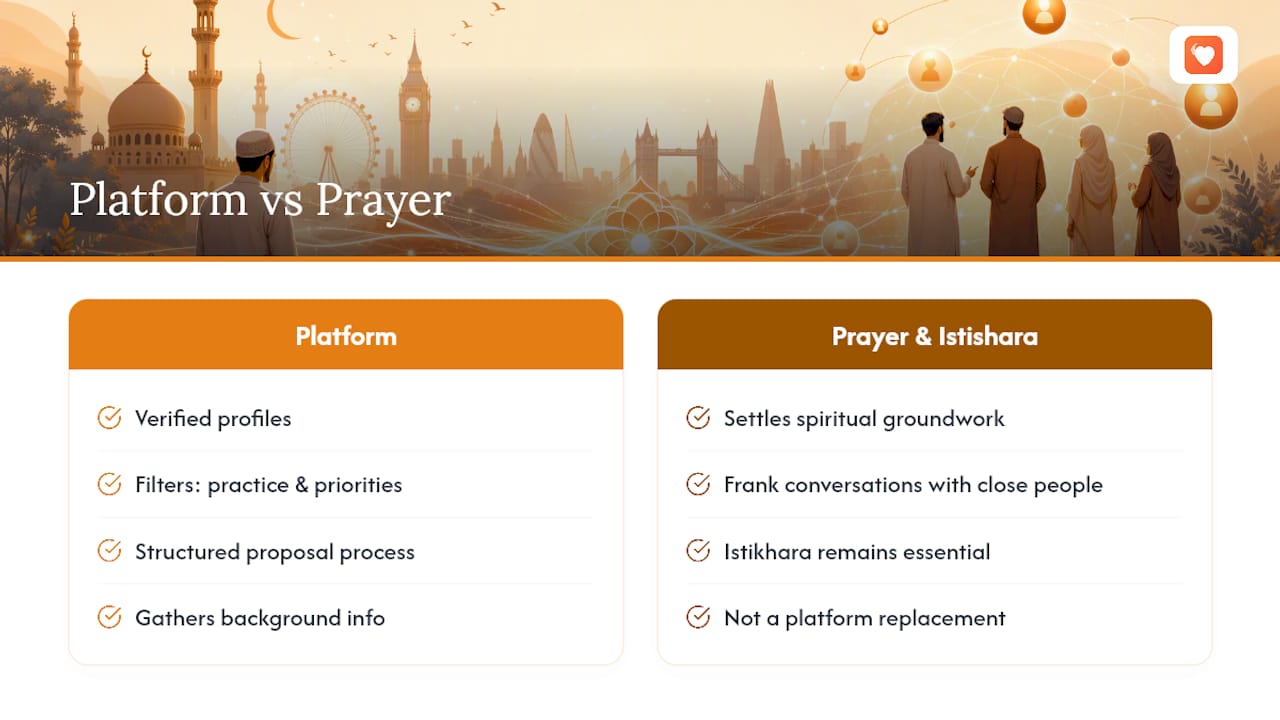
That's the gap a platform built specifically for marriage, rather than casual dating, is designed to close. Verified profiles, filters based on religious practice and life priorities, and a structured proposal process mean you're doing your practical groundwork on people who are actually looking for marriage, not guessing at intentions from a dating app built for something else entirely. Used well, a tool like Zawajmarriage can support the istishara stage by helping you gather the background information you'd otherwise have to ask around for.
None of this replaces the prayer itself or a frank conversation with people who know you well. It simply makes the practical side of the search less of a guessing game, so istikhara has a real, specific proposal to be prayed about in the first place.
— Muhammad
Finding a spouse-focused platform after your istikhara
If you've prayed istikhara, consulted people you trust, and you're now ready to actually meet someone with marriage in mind, the search itself is often where people get stuck, stuck between apps built for dating and family networks that only stretch so far. There are platforms built specifically for those serious about marriage rather than casual conversation.

Profiles go through verification, filters let you narrow down by religious practice and background rather than swiping blindly, and the proposal system keeps interactions purposeful instead of open-ended messaging with no direction. It also supports those considering a second marriage, a search that's often harder to navigate through family networks alone. If you're at the stage where istikhara has settled your intentions and istishara has sharpened your criteria, explore Zawajmarriage and set up a profile that reflects exactly what you're looking for in a spouse.
Sources
The hadith underpinning istikhara's wording and procedure comes from Sahih al-Bukhari 6382, preserved in detail by Dar al-Ifta. For procedural questions, Islamic Relief Worldwide's guide and Islamweb's fatwa cover timing and eligibility clearly. For the deeper purpose behind the prayer, Yaqeen Institute's guide and SeekersGuidance's answer on istikhara are worth reading in full. For questions specific to your own situation, a local, qualified scholar remains the right port of call.