
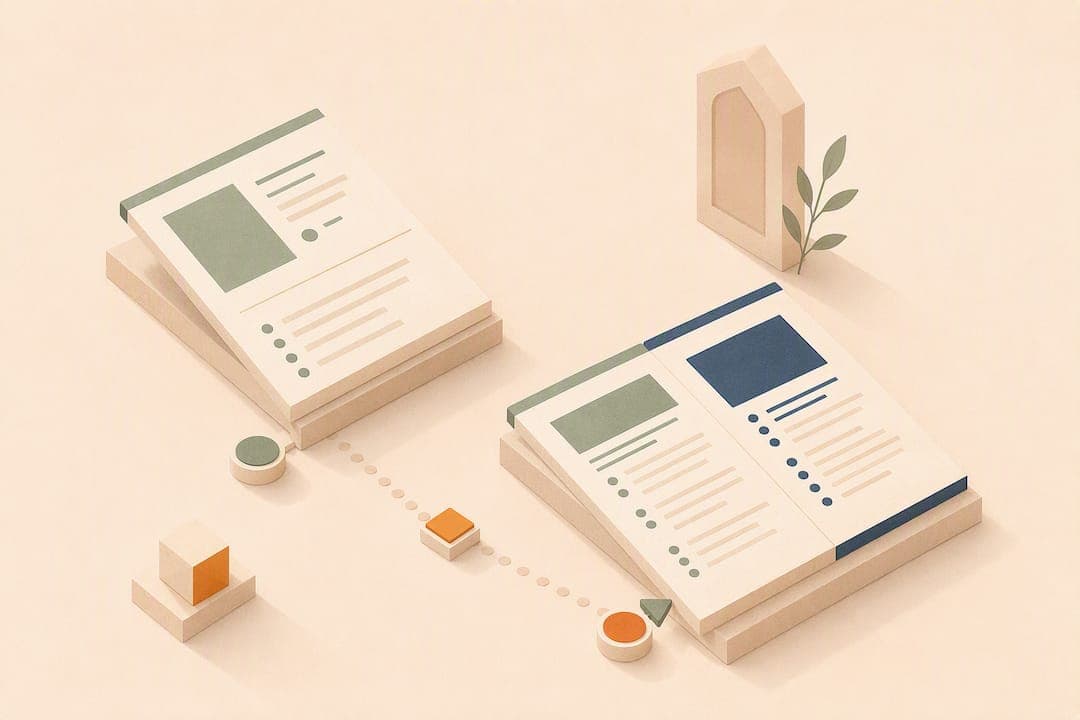
A Muslim marriage biodata is a concise, usually one to two page document that presents a person's personal details, religious practice, family background, education and partner preferences to a prospective spouse's family. It typically opens with an invocation, then covers personal fields, religious details, family and wali contact, education and profession, an "About Me" note, partner preferences and a recent photograph. Most families exchange it as a PDF, though an editable Word master is standard practice too.
TL;DR:
- Precise personal details, including full name, date of birth, height, and residence, are essential to avoid confusion and ensure compatibility.
- Religious and family background information must be clear and honest, especially sect, maslak, and wali contact, to facilitate genuine matching.
- PDF is the safest format for sharing biodata, with a Word master kept for updates, and layout consistency keeps the document professional and readable.
- Verifying facts against official documents and removing photo metadata are crucial steps to protect privacy and prevent mismatched information.
- Using structured platforms like Zawaj can improve match quality by enforcing verification, better filtering options, and traceable communication.
Table of Contents
- What is a Muslim marriage biodata and what must it include?
- Choosing a template and file format (PDF, Word, A4 print-ready)
- How do you create, check and share your biodata step by step?
- Photo, layout and presentation tips for a respectful, effective biodata
- How do you state sect, maslak and biraderi without causing offence?
- Checklist and common mistakes to avoid before you send a biodata
- How does a halal matrimonial platform put these standards into practice?
- Why clear biodata leads to more serious proposals
- Where Zawaj fits into your biodata and matchmaking process
- Sources
What is a Muslim marriage biodata and what must it include?
A biodata works because families can scan it in under a minute and know whether to pursue an introduction. Get the fields wrong or leave one vague, and the document does the opposite of its job: it raises questions instead of answering them.
Start with the invocation. Most Islamic biodata format templates open with "Bismillah ir Rahman ir Rahim" centred at the top, sometimes followed by a Hadith or Quranic verse about marriage. It sets the tone before a single personal detail appears.
Personal details come next, and precision matters more than most people think:
- Full name as it appears on official documents, not a nickname.
- Date of birth and current age stated together, since ages calculated from a DOB sometimes drift by a year depending on when the reader checks.
- Height, given in feet and inches or centimetres, consistently with how you describe partner preferences later.
- City and country of residence, plus willingness to relocate if that's relevant.
Religious details follow. State sect (Sunni, Shia, or otherwise) and maslak (Hanafi, Salafi, Deobandi, and so on) plainly, rather than vaguely. Practising level deserves honest, specific wording: "prays five times daily," "currently building consistency in daily prayer," or "practising, with room to grow together" all read as more trustworthy than a generic "religious" or "moderate."
Family background should name parents' occupations, number of siblings, and their marital status, alongside a wali (guardian) contact name and number. This is often the single most-checked field, since it tells the receiving family who to actually negotiate with.
Education and profession get stated as qualification, institution, and current role. Income is optional; when included, a bracket ("mid five figures," a job title implying seniority) works better than an exact figure. Close with a short "About Me" paragraph on personality and values, and a partner preferences section covering typical expectations on age, education, and practice level, stated without exact numeric ranges.
Choosing a template and file format (PDF, Word, A4 print-ready)
A single page suits most first introductions; two pages only make sense for a detailed sample marriage biodata with an extended family section or a professional CV-style layout for someone with a longer career history. Beyond two pages, families tend to skim rather than read, which defeats the purpose.
PDF is the safer format for sharing because it locks the layout. Whatever font, spacing, and photo placement you set stays fixed on the recipient's screen, whether they open it on an old phone or a laptop. Keep a Word version as your editable master copy so updates (a new job title, a change in city) don't mean rebuilding the document from scratch.
A few design habits separate biodata that gets read properly from biodata that gets glanced at:
- Use a conservative serif or clean sans serif font. Nothing decorative.
- Set A4 print margins from the start if there's any chance a family will print it for a physical meeting.
- Keep file size under roughly 2MB. WhatsApp compresses larger PDFs, sometimes badly enough to blur a photo.
- Leave generous white space between sections rather than shrinking font size to fit everything on one page.
Pro Tip: Save your Word master with a version number in the filename (Biodata_v3.docx). When you inevitably update your profession or city six months later, you'll thank yourself for not hunting through old email attachments.
How do you create, check and share your biodata step by step?
Building a biodata properly takes an evening, not a weekend, if you work through it in order rather than jumping between sections.
- Gather your facts and documents first. Confirm your exact date of birth against your ID, get your parents' correct occupational titles, and confirm your wali's current phone number before you write anything.
- Draft in the standard sequence: invocation, personal details, religious details, family background, education and profession, About Me, then partner preferences. Writing out of order tends to produce a document that reads disjointed.
- Proofread for consistency, not just spelling. Check that the age matches the date of birth and that your stated practising level doesn't contradict itself between the religious section and About Me.
- Strip photo metadata before attaching it. Phone photos carry EXIF data, including GPS location, embedded in the file. Most phones let you remove this on export, and it's worth checking your app's own privacy settings before you upload or send anything through a matrimonial app, per Google's privacy policy on how apps should handle user data.
- Export as PDF for sharing, save the Word file separately as your editable master.
- Keep a simple log of who received a copy and when. A spreadsheet with three columns, name, date sent, and channel, saves confusion three months into the process when three families are all asking follow-up questions.
Photo, layout and presentation tips for a respectful, effective biodata
The photo carries more weight than most people assign it. Choose a recent head-and-shoulders shot against a plain background, in modest dress appropriate to your community's expectations. Avoid group photos, filters, or anything cropped awkwardly from a wedding or holiday picture, since it signals the biodata was thrown together rather than prepared with care.
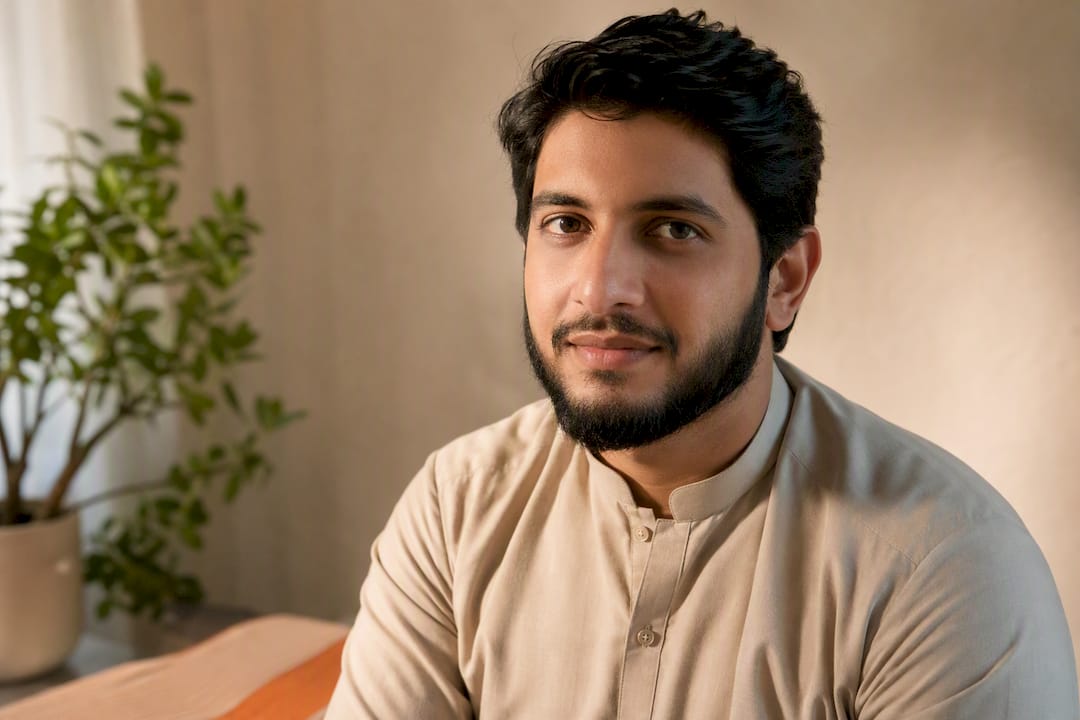
Remove EXIF metadata before sending, particularly if you're sharing through an app where you're unsure how the platform handles uploaded images, in line with the disclosure standards set out in Google Play's app policies.
For layout, keep font size no smaller than 11pt, use consistent line spacing throughout, and limit colour to one accent shade at most, headings in a muted blue or green work well, everything else in black text.
Pro Tip: When sending via WhatsApp or email, name the file with your first name and "Biodata" (e.g. "Amina_Biodata.pdf") and add one short line in the message itself. It reads as more considered than an unlabelled attachment with no context.
How do you state sect, maslak and biraderi without causing offence?
These fields exist because families use them as genuine compatibility filters, not as boxes to tick for the sake of it. A mismatch discovered after several conversations wastes everyone's time far more than stating it clearly up front.
For sect and maslak, neutral, factual phrasing works best: "Sunni, Hanafi" or "Sunni, no specific maslak, open to compatible practice" both read as clear rather than restrictive. Practising level benefits from the same honesty used in the personal section: state where you are, not where you aspire to be.
Biraderi (caste or clan background, common in South Asian Muslim communities) is optional and increasingly left out or marked "no bar." When you do include it, a short, factual line is enough:
- "Biraderi: [name], open to all backgrounds" signals flexibility without erasing identity.
- "Sect: Sunni, open to Shia matches" works for families genuinely open across sectarian lines, though it's worth confirming this reflects both the individual's and the family's actual position before printing it.
- Avoid vague terms like "flexible" alone. Pair flexibility with what you're actually flexible about.
Checklist and common mistakes to avoid before you send a biodata
Run through this before any biodata leaves your hands, not after it's already been shared with three families.
- Confirm every fact against a document, not memory, name spelling, date of birth, guardian's phone number.
- Check what you haven't included. Financial specifics and medical history don't belong on an initial biodata; those conversations happen at the family meeting stage, once there's genuine mutual interest.
- Confirm cultural basics are present: invocation at the top, sect and practising level stated if your community expects it, and no mention of Mehr amount, which is a negotiation for later, not a marketing detail.
- Check internal consistency. The single most common error reviewers flag is a biodata stating "very religious" in one section and something noticeably softer, like "flexible on practice", in the About Me paragraph a few lines down. Reviewers notice this contradiction faster than almost anything else on the page, since it's the first thing that reads as inconsistent.
Pro Tip: Ask someone outside your immediate family to read your draft once. They'll catch the contradictions and awkward phrasing that you've stopped seeing after your fifth edit.
How does a halal matrimonial platform put these standards into practice?
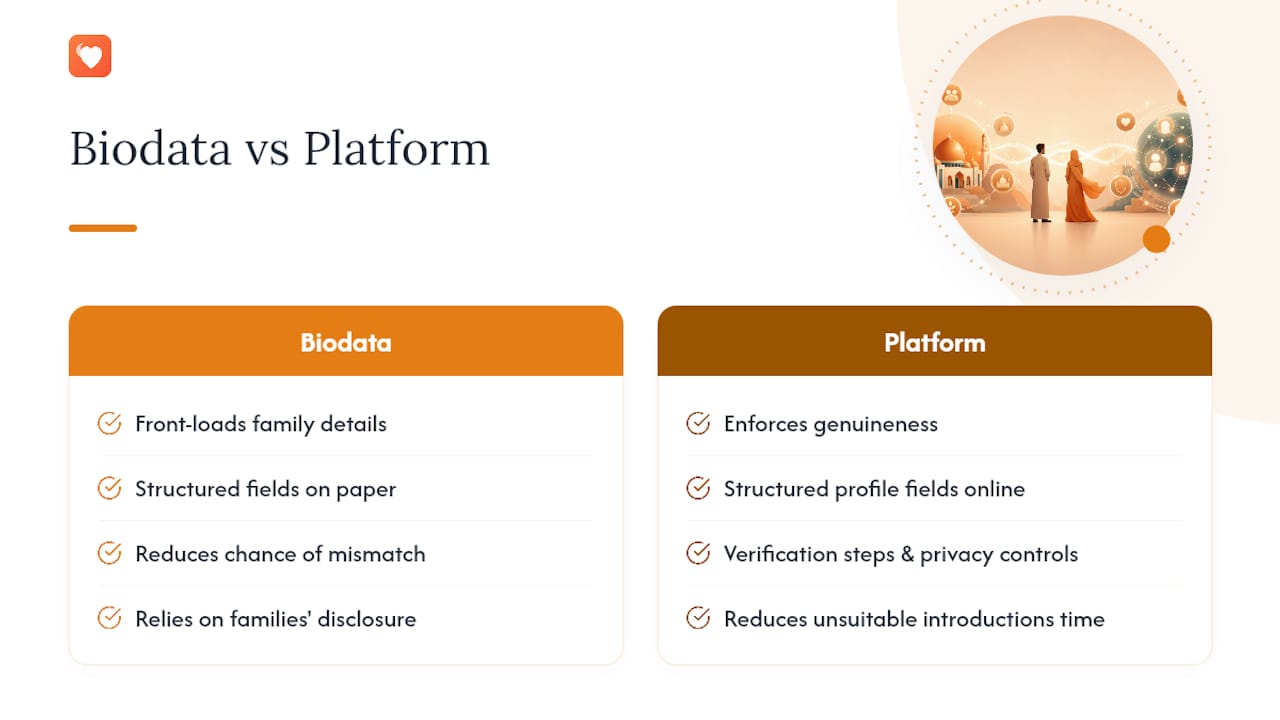
Good biodata practice and good platform design solve the same problem from two directions. A well-built biodata front-loads the details a family needs; a well-built platform enforces that those details are genuine and that private information doesn't circulate carelessly.
On Zawajmarriage, biodata-style fields, personal details, religious practice, family background, and partner preferences, map directly onto structured profile fields rather than free text, which reduces the chance of a mismatch slipping through. Verification steps and privacy controls around messaging and proposal sending exist specifically to cut down on the kind of misuse that makes families cautious about sharing biodata widely in the first place.
Verification and clear filtering on a matrimonial platform reduce the time spent on unsuitable introductions and give people more control over who sees their private details in the first place.
That's the underlying logic behind every field this guide has walked through: precision protects both parties, and the right platform structure carries that same principle from paper into practice.
Why clear biodata leads to more serious proposals
A biodata that says what it means, in plain language, saves everyone time. I've seen the same pattern play out repeatedly across matrimonial contexts: vague fields produce vague interest, and vague interest rarely turns into a serious proposal. The families who write "practising, five daily prayers, still working on Quran memorisation" get further than the ones who write "religious" and hope it covers everything.
Treat your biodata as a working document, not a formality to get out of the way before the real conversations start. Update it as your circumstances change, and share it deliberately rather than sending it to every family who asks. If you'd rather build and manage this process inside a structured platform instead of juggling PDF versions over email, that route exists too.
— Muhammad
Where Zawaj fits into your biodata and matchmaking process
Once your biodata is written, the real question becomes where to share it safely, and that's where a traditional PDF-by-WhatsApp approach starts to show its limits. There's no way to verify who's actually receiving it, no filter for compatibility, and no record of who's genuinely serious.
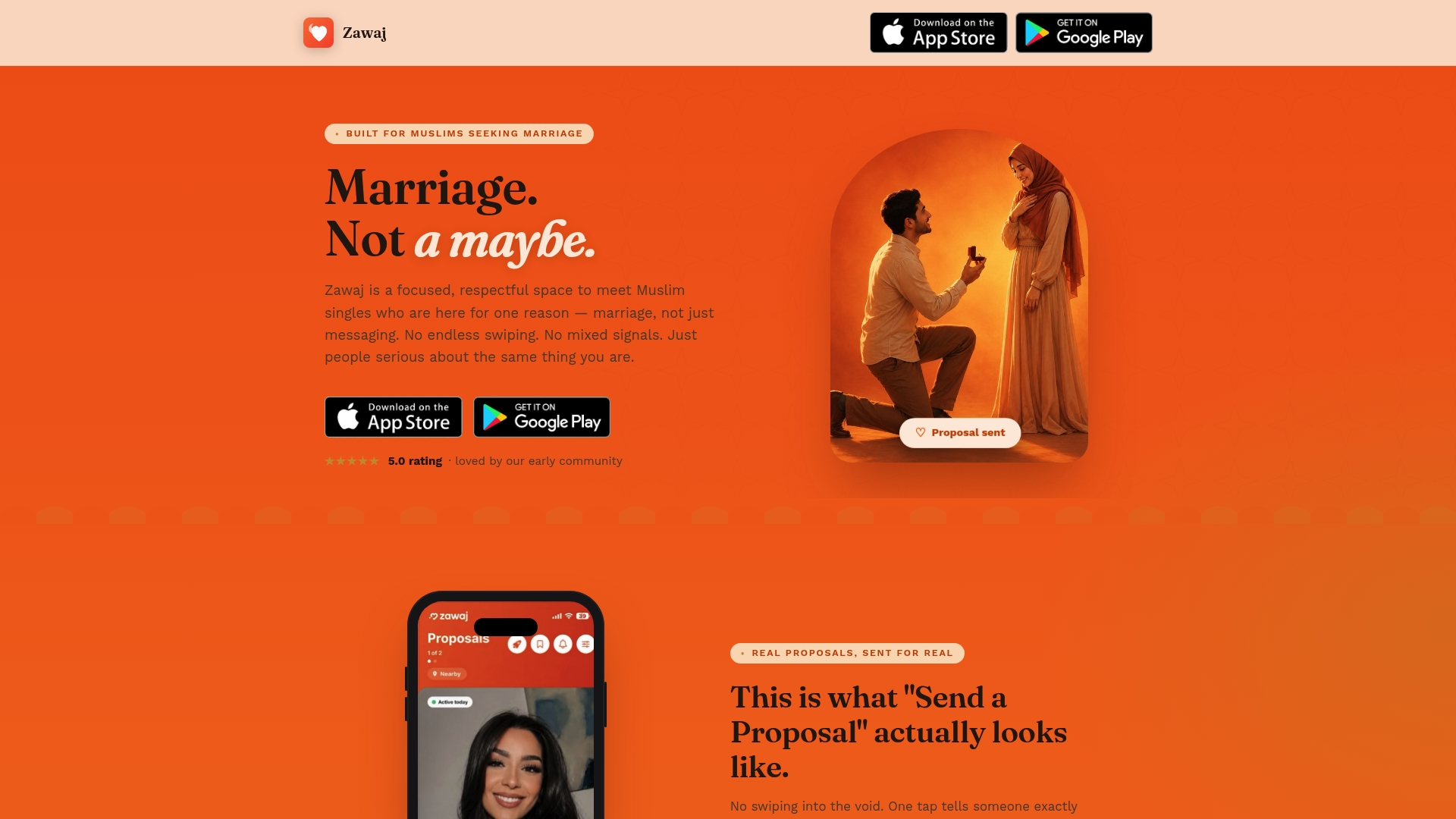
Zawaj uses biodata fields, religious practice, family background, education, and partner preferences in a verified profile structure designed for intention-driven marriage. Filters allow searching by criteria such as sect, maslak, and practising level to focus on compatible matches. Proposal sending and in-app messaging keep conversations contained and traceable rather than scattered across email threads and forwarded PDFs. If you've already done the work of writing an honest, detailed biodata, create your Zawaj profile and put those same details to work in a space built to take them seriously.