
This article gives you a Shariah-aware premarital question bank organised by priority topic, from deen and character through to money, family, and intimacy. You'll find extended lists for detailed counselling sessions and condensed checklists for a single meeting, alongside guidance on taaruf, istikhara, and when to bring in an imam or therapist. If you only need a fast screening tool, skip ahead to the 30-question and 10-question checklists near the end.
TL;DR:
- Focus on splitting questions into two or three conversations, prioritizing deen and character before discussing financial or family details.
- Ask about religious practices, community involvement, and theological differences, emphasizing ongoing growth and willingness to discuss differences.
- Clarify family boundaries, expectations for in-law interactions, and independence to prevent conflicts rooted in unspoken assumptions.
- Discuss money and mahr early, ensuring mutual understanding without rushing negotiations, and consider legal implications of civil registration depending on your location.
- Be honest about previous marriages, health issues, and past relationships, recognizing that concealment undermines informed consent and trust later in marriage.
Table of Contents
- How to ask premarital questions in Islam without turning it into an interrogation
- Religious life and practice: questions to assess deen and spiritual compatibility
- Family, in-laws, and boundaries: what happens after the wedding
- Money, mahr, and financial expectations before the nikah
- Children, parenting, and Islamic education
- Intimacy, health, and honesty about the past
- Previous marriages, past relationships, and honesty as a foundation
- Communication and conflict: how will you actually argue?
- What to do after the conversations: istikhara, counselling, and legal steps
- Condensed checklists: 30 questions and the essential 10
- Why I think most premarital question lists get the order wrong
- Using Zawaj to structure these conversations the right way
- Sources
How to ask premarital questions in Islam without turning it into an interrogation
Taaruf, the Islamic process of purposeful mutual introduction, works best when both people understand its limits before the first conversation happens. It's not dating with a religious label attached. Scholarly guidance is clear that meetings should stay chaperoned, avoid khalwa (being alone together in circumstances that invite suspicion), and involve a wali or trusted third party wherever practical.
The biggest mistake people make with a long question list is treating it as a script to complete in one sitting. Practitioners who run premarital counselling recommend the opposite: split the questions across two or three calmer conversations, and put deen, values, and family alignment first before touching anything sensitive. Get the fundamentals wrong and the rest of the list is academic anyway.
A workable meeting structure looks like this:
- First conversation: religious practice, character, family background, life goals.
- Second conversation: finances, living arrangements, children, and parenting philosophy.
- Third conversation (often with a counsellor or imam present): intimacy, health disclosures, past relationships, and any red flags that surfaced earlier.
Watch the pace as much as the content. If someone deflects the same question twice, or the conversation feels more like cross-examination than mutual discovery, that's a signal to slow down and bring in outside counsel rather than push harder.
Pro Tip: Write your questions down beforehand and share the topic areas (not the exact wording) with the other person ahead of time. It reduces the ambush feeling and usually gets you more honest answers.
Religious life and practice: questions to assess deen and spiritual compatibility
Islamic guidance is unambiguous about what should top the list. The emphasis on religion and character as the primary criteria for choosing a spouse comes directly from hadith, including the well-known instruction to prioritise a person's deen above wealth, lineage, or appearance. Everything else on this list matters, but this section matters most.
Work through these in order, adjusting language to fit the conversation naturally rather than reading them like a form:
- How would you describe your relationship with your five daily prayers, honestly, not aspirationally?
- Do you read or study the Quran regularly, and is that something you want to build together?
- Have you attended halaqas, Islamic classes, or sought religious knowledge in the past few years?
- What role does the masjid or wider Muslim community play in your week?
- Which madhhab or school of thought do you generally follow, and how did you arrive at it?
- Are there scholars or teachers whose guidance you particularly trust, and why?
- How do you personally define religious growth, and where do you feel you're weakest right now?
- What does a religiously balanced household look like to you, practically, day to day?
- How important is it that both partners pray together or attend Islamic events as a couple?
- Where would you draw the line between cultural practice and religious obligation?
Questions 5 and 6 deserve a gentler touch than the rest. Asking about madhhab or aqeedah isn't about scoring theological points. It's about understanding whether daily practicalities like prayer timing conventions, fiqh on food, or approaches to family disputes will create friction. Two people from different schools of thought can build a strong marriage; two people who refuse to discuss the differences beforehand often can't.
Not every mismatch is a deal-breaker. Someone who prays inconsistently but is genuinely working on it is a different prospect from someone who dismisses the question entirely. The real warning sign isn't imperfection, it's an unwillingness to acknowledge where they stand or any intention to grow. Fundamentals worth treating as non-negotiable typically include belief in the core tenets of Islam and a demonstrated, ongoing commitment to practice, even if that practice is still developing.
Family, in-laws, and boundaries: what happens after the wedding
Marriage in Islam connects two families, not just two individuals, and that's exactly where a lot of avoidable conflict starts. Getting clarity before the nikah saves both people from discovering irreconcilable expectations six months into married life.
Cover these areas directly:
- How often do you expect to visit or host your parents and siblings, and is that negotiable?
- Would you expect us to live with your parents, near them, or independently, and for how long?
- What financial support, if any, do you currently provide to your parents or siblings, and will that continue?
- Who takes primary responsibility if a parent needs caregiving in the future?
- How much privacy do you expect your family to respect once we're married, in terms of visits, calls, and decisions?
- Has your family expressed strong opinions about who you marry, and how do you handle disagreement with them?
The UK guidance on Muslim marriages recommends addressing family boundaries explicitly during premarital counselling precisely because unspoken assumptions cause more damage than disagreed-upon rules. A couple who has argued about in-law visits before the wedding is in a far stronger position than one avoiding the topic to keep the peace.
Certain answers deserve real caution rather than a shrug. A prospective spouse who insists you cannot make independent decisions without parental approval, demands secrecy about the relationship's terms, or shows controlling behaviour when family boundaries come up, is showing you a pattern that rarely improves after marriage. Excessive interference from either side, financial demands presented as non-negotiable, or a refusal to discuss caregiving plans at all are worth raising again, ideally with an imam or counsellor present, before moving forward.
Money, mahr, and financial expectations before the nikah
Financial mismatches sink marriages as often as religious or family conflicts do, and yet many couples discuss money less than almost any other topic on this list. Get specific early.
Ask directly:
- What is your current income, and does it come from halal sources?
- Do you have existing debts, and what's your plan for managing them?
- How would you describe your saving habits versus spending habits?
- Do you expect a joint account, separate accounts, or a hybrid arrangement, and why?
- Are you currently supporting parents or dependants financially, and will that continue?
- What are your expectations around mahr, in terms of amount, form, and timing?
On mahr specifically: treat this as a conversation about meaning and expectations, not a negotiation to finalise in the first meeting. Mahr is the bride's right, not a family transaction, and its value can be financial or non-financial depending on what's agreed. Bring an imam or someone with knowledge of marriage contracts into the conversation once amounts or conditions are being discussed seriously, rather than trying to settle terms between two people still getting to know each other.
If you're marrying in the UK, there's a practical legal point worth knowing early: a Nikah performed without separate civil registration does not automatically create legal rights under English law. That distinction matters for financial protection specifically, since it affects inheritance and asset division should something go wrong later. It's worth raising as a practical question rather than an afterthought: will the nikah be paired with civil registration, and when?
Children, parenting, and Islamic education
Whether and how you'll raise children shapes almost every other decision in a marriage, from where you live to how you spend weekends. Get this on the table before the wedding, not after the first pregnancy.
Discuss:
- Do you want children, and if so, roughly how many and starting roughly when?
- What would an ideal family size look like to you, and how flexible is that number?
- Do you lean towards Islamic schooling, mainstream state schooling, or home education, and why?
- Who will lead on daily religious instruction, Quran memorisation, and Islamic manners at home?
- How do you imagine dividing childcare and household responsibilities once children arrive?
- How will you handle grandparents who want more involvement in parenting decisions than you're comfortable with?
Schooling in particular tends to surface disagreements that seemed irrelevant during dating-stage conversations. One partner picturing a full-time Islamic school and the other assuming standard state education with weekend Islamic classes is a genuinely different vision of family life, not a minor logistical detail. Sort out the broad direction now, even if the specific school choice waits until children exist.
Intimacy, health, and honesty about the past
This is the section most people find hardest to approach directly, and it's also where dignity matters as much as honesty. Islamic guidance supports frank discussion of intimacy and health within marriage while discouraging language that shames or humiliates.
Useful phrasing tends to be indirect in tone but direct in content:
- "Is there anything about your health, past or present, that you feel I should understand before we marry?"
- "Have you had any medical issues that might affect starting a family, and have you had that checked?"
- "What are your expectations around intimacy within marriage, and is there anything you'd want to discuss now rather than later?"
- "Is there anything from your past you'd want a doctor or counsellor to know before we're married, even if it's not something you're comfortable discussing directly with me?"
Sexual health, fertility concerns, and any history that could affect the marriage are legitimate topics, and concealing a known, relevant medical issue raises real ethical questions about informed consent to the marriage contract. Encourage honesty by asking gently rather than accusingly, and accept that some disclosures are better made to a doctor or counsellor first, with the outcome relayed to you afterwards rather than every clinical detail shared directly.
Pro Tip: If either of you feels too uncomfortable to discuss a health or intimacy topic directly, that discomfort is itself useful information, not a reason to skip the question. A licensed therapist or GP can often mediate that specific conversation far better than either of you can alone.
Previous marriages, past relationships, and honesty as a foundation
Concealing a previous marriage, a divorce, or children from an earlier relationship isn't a minor omission. It undermines the informed consent that the nikah contract depends on, and it tends to surface eventually, usually at the worst possible moment.
Work through the following with care:
- Have you been married before, and if so, what led to the marriage ending?
- Do you have children from a previous marriage, and what are the current custody or access arrangements?
- What financial obligations, if any, remain from a previous marriage?
- How do you feel your previous marriage shaped what you're looking for now?
- Is there anything about a past relationship, Islamic or otherwise, that you think I should know before we go further?
Reasons for a previous divorce deserve genuine curiosity rather than judgement. Someone who can reflect honestly on what went wrong, including their own part in it, is showing emotional maturity that matters more than the divorce itself. Someone who blames an ex-spouse entirely, refuses to discuss it, or gives inconsistent versions of events across different conversations is showing you something worth taking seriously.
If red flags appear here, pause the process rather than pushing through it. Bring a trusted family member, imam, or counsellor into the conversation, and check whatever references or background information you reasonably can before moving towards nikah.
Communication and conflict: how will you actually argue?
Every couple disagrees. The question that predicts marital success isn't whether conflict happens, it's how each person handles it when it does.
Ask about patterns rather than hypotheticals:
- How do you typically react when you're angry, and what usually helps you calm down?
- Do you prefer to talk things through immediately, or do you need space first?
- What does a genuine apology look like for you, in words and in action?
- Would you want family or a mediator involved in a serious disagreement, or would you prefer to keep it between us?
- Have you ever sought therapy or counselling, and how do you feel about doing so if we needed it?
- What kind of emotional support do you need during a hard week, and how do you usually ask for it?
One practical exercise recommended by premarital counsellors is worth trying between conversations rather than during them: each person writes two sentences, one describing what they value most in how the other communicates, and one naming a single area they personally want to improve. Swapping these afterwards, calmly, converts an abstract conversation about "communication styles" into something concrete both people can actually work on.
What to do after the conversations: istikhara, counselling, and legal steps
Once the core questions have been asked and answered honestly, the next step is spiritual, not just administrative. Istikhara, the prayer for seeking guidance, is widely recommended alongside practical checks rather than as a substitute for them. Praying istikhara after gathering solid information, not instead of it, reflects the balance Islamic guidance encourages between spiritual reliance and due diligence.
Who to consult depends on what's still unresolved:
- An imam is the right person for questions about religious rulings, mahr structure, marriage contract conditions, or how to reconcile differing fiqh positions between partners.
- A licensed therapist is better placed for trauma history, mental health concerns, or communication patterns that need structured, ongoing work rather than a single conversation.
- Both together make sense when a couple wants a fuller premarital counselling process that covers religious obligations and relational skills side by side.
If you're marrying in the UK, one brief practical point is worth repeating here rather than assuming it's already understood: a religious Nikah ceremony alone typically doesn't create the same legal protections that a registered civil marriage provides under English law. Couples who want those protections generally need to register the marriage civilly as well. This is general information rather than legal advice, and anyone with specific concerns should speak to a solicitor.
Pro Tip: Don't treat istikhara as a one-off prayer said the night before a decision. Many scholars recommend praying it consistently over several days while continuing the practical process, then noticing which direction feels clearer and more at ease over time.
Condensed checklists: 30 questions and the essential 10
For a first meeting or a chaperoned introduction where time is limited, a shorter, prioritised question set works better than an exhaustive one. Use the 30-question version below as a working template, drawing from the fuller lists above for topics that need deeper discussion later.
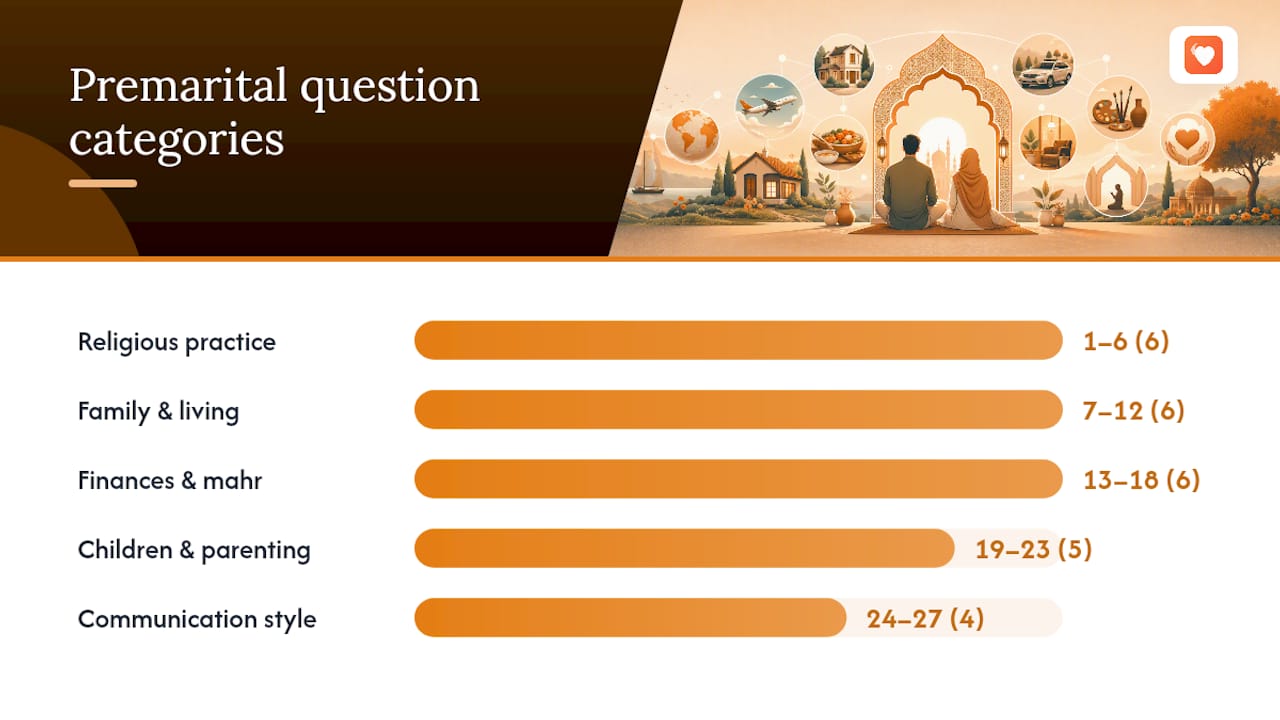
The 30-question checklist spans: religious practice and goals (questions 1 to 6), family and living arrangements (7 to 12), finances and mahr (13 to 18), children and parenting (19 to 23), communication style (24 to 27), and health or past relationships (28 to 30), with the final three reserved for a more private, later conversation rather than a first meeting.
If time is genuinely short, prioritise the essential 10: prayer and religious practice, view on mahr, income and debts, desire for children and schooling preference, family living expectations, conflict resolution style, and honesty about any previous marriage. Everything else can wait for the second conversation.
Why I think most premarital question lists get the order wrong
Most guides treat these questions as a flat checklist, everything equally weighted, everything asked in one sitting. That's backwards. The hadith guidance on prioritising deen and character exists precisely because getting the fundamentals right makes the rest of the conversation easier, not harder. Two people aligned on faith and values can work through a financial disagreement. Two people aligned on finances but mismatched on deen usually can't paper over that gap indefinitely.
The other mistake is treating a long questionnaire as a substitute for judgement. A 30-item list is a prompt for reflection, not a scoring system. Combine the practical work here with istikhara and honest counsel from people who know you, and trust that process more than any single answer on a page.
— Muhammad
Using Zawaj to structure these conversations the right way
Having the right questions matters less if you never meet someone worth asking them. A halal matrimonial app can help by providing verified profiles and filters to search by religious practice and background, emphasizing serious interactions oriented towards marriage rather than casual chat.

A proposal system on such platforms can give structure to expressing serious interest formally rather than guessing at intentions through messaging alone, and in-app messaging can keep early conversations contained and purposeful rather than open-ended. None of this replaces istikhara, an imam's guidance on religious matters, or a therapist for issues that need clinical support. It simply gets you to the right conversation with the right person faster. If you're ready to put a faith-aligned question bank like this one to actual use, set up a verified profile on Zawaj and start filtering for the compatibility that matters most.